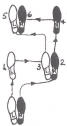
Coaches teach footwork. Coaches talk about footwork. Coaches point out examples of good footwork to students while at competitions. How many coaches,however, use footwork in their lesson? Often when I watch a coach give a lesson, there is some random footwork while the student tries to keep pace. Suddenly, the coach stops and cues an action from the student. The student executes the action, and the coach returns to making random advances and retreats with the student gamely trying to keep some arbitrary distance.
There is a better, smarter way to use footwork in the lesson. By building your lessons around commonly used patterns of footwork, you accomplishes several things:
- Patterning footwork in the lesson makes advanced lessons easier for you to teach.
- Your students understand very quickly that footwork is a necessary skill for fencing, and there is a way to approach using and learning it.
- Your students learn to integrate footwork with attacking and defending blade actions.
- Your students practice footwork in the lesson with a specific purpose and objective.
Consider a simple footwork pattern in lesson: your student's pattern is to make a single advance. The student starts slightly out of distance from you, and makes an advance in preparation. You have two choices on your student's advance: you retreat at the same time that the student advances, to deny the student the proper distance to attack. Or, you do not move, and the student closes the space. If you choose to open the space, the student ends his or her advance without attacking you. If you stand still, the student will see immediately that the distance is closing and they should make an attack.
Purists can argue that one advance is not a "pattern", but that discussion misses the point. This simple lesson encompasses all the concepts behind using a footwork pattern in a lesson:
- The pattern is known to both you and your student.
- The pattern is initiated by the student.
- The student makes a decision during the execution of the pattern depending on the results of the footwork.
- You retain control over the lesson by your choice of responses to the pattern, or your actions during the pattern.
To win bouts, fencers must learn to control distance. To control distance, the student must use footwork. What the student learns in lesson is what they will take to the strip. If you are not teaching the student to use footwork both offensively and defensively in lesson, the student fail to do so in a bout. Controlling and using distance is something that must be taught, and that can be taught. This teaching must begin at the start of your student's careers. Students must feel what it is like to initiate footwork action and to asses the distance that they've created while gauging the response of the opponent. Without practice in lesson, the student is forced to learn this on the strip: a valuable place for lessons, but an expensive one.
Some thought must be given to matching the footwork pattern to the blade action(s) you are teaching in that day's lesson. A simple lesson in attacking may have simple attacking footwork: advance, lunge/fleche, advance-lunge/fleche. The footwork should have one preparation step (and advance or retreat) and a "decision" step. In the example of the advance in preparation, the student prepares with an advance. During the advance the student makes the decision whether to use the attacking footwork (lunge) or not. The pattern might be longer, with additional preaparaiton steps coupled with blade preparations.
The footwork preparation is as important as the finishing footwork. If you deny your student the distance necessary to finish with an attack, the student must remain poised, composed, and (eventually) ready to make an additional footwork phrase to either escape a (new) offensive response by your or to follow you while looking for another opportunity to attack. This gives your student a level of control which is more bout-like. Here, the student makes the decision to attack or not to attack based on the sitatuions they observe, and not because you have artificially given a "cue". If the distance is correct (because your student has made it so, or because you have allowed it to become so) the student attacks. If it is not correct, the student declines the attack. These are the sorts of decisions that have to be made in a bout constantly, and are realistically simulated with just this type to lesson.
Your student initiates and "leads" the footwork, but does not control the entire lesson. You still have choices on whether the student's footwork is "successful" or not by choosing to open the space or to let space collapse. With a beginning to intermediate student, there is a need to channel the lesson into specific skill areas which often revolve around common footwork patterns, such as the "push pull" pattern in épée, or the "long chase" of saber.
From the idea of making one advance as a footwork pattern, we can expand the concept to include more than one step, and steps in different directions. This expands both the opportunty for more preparation, and for increased complexity of actions. If a retreat is added into the example above, the pattern becomes: "advance, retreat". Now the student advances and retreats while you follow. Your student is still leading the footwork and looking for an opportunity to attack you. You are still in control of the lesson by deciding how far to advance and retreat, and how late or early to advance and retreat. By changing one of the parameters of your step—for example, by retreating late on the student's advance—you can still "cue" the attack. The student reads the collapse of the distance as the time to execute an attack.
Using footwork patterns allows you to build more advanced concepts of footwork rhythm into a lesson. In the "advance, retreat" pattern above, you can tell your student to make several repetitions of the pattern at a constant rhythm. Then you can instruct the student to make the retreat very short and start the next advance very quickly. The student will use this change of rhythym and the size of their step to catch you in the wrong space, and should find it easy to score against you. Exercises like this teach the student tactical rhythm and speed/drection changes in the bout. You can add more difficulty by sometimes being "unaware" of the student's change and getting hit, or paying close attention to the student and "escaping" the change, requiring the student to not over commit in the acceleration of his or her footwork and to be aware of the distance at all times.
Consider another example: "advance, advance, retreat". A number of actions can be built into this pattern. Each action will give the pattern a different character. For instance: the student makes the first advance at one speed and then makes the second advance very quickly after the first to draw an attack in preparation from you. Your student retreats and makes a parry riposte to score.
You may also construct a framework of footwork that the student may "break out" of and score. The "break out" occurs when the attacking footwork is added to the "maneuvering" or "base pattern" that the student is repeating. This is an excellant way to introduce push/pull actions that end with the student making an accelerating attack or in riposting against a poorly time attack in preparaion. The student can also be encouraged to add variations to create opportunities to attack, such as changing the pattern "advance, retreat, retreat" into "advance, retreat, advance". The student gains more control by being able to surprise the coach, who may know what action will be done by the student (the change of direction of the final step of the pattern) but not when the change will take place.
Resist the urge to make complicated patterns: "advance, retreat, double advance, check, double retreat" is a wonderful pattern, but who could remember all that? The student should be focusing on executing simple patterns in footwork without having to keep a running tally of the number of steps and their direction. Patterns of more than two or three steps are probably more harmful than helpful. Once movement is added to blade mechanics, the lesson becomes difficult for the student, very quickly. Start with simple patterns of one or two steps with simple blade work. The example of using the advance in preparation is worth a month of lessons all on its own. Advance fencers score with simple actions at the right time and the right place. That should be the guiding principal of the construction of the lessons.
It is never too early (or too late) to integrate footwork patterns in a fencers training. Any blade action new to the student can be introduced while the coach and student are standing still. Once roughly mastered, it should be incorporated into the footwork pattern best suited for it. The integration will be poor at first, but will improve with practice.
Modern fencing is defined by movement. Add this component early in the student's career.
Written: October 2005, last edited and updated, February 2013.
Copyright © 2008 by Allen Evans. This article may be reproduced freely, as long as it remains unmodified and his copyright notice is included.